HomeWhich portable power stations can run a sump pump
Which portable power stations can run a sump pump
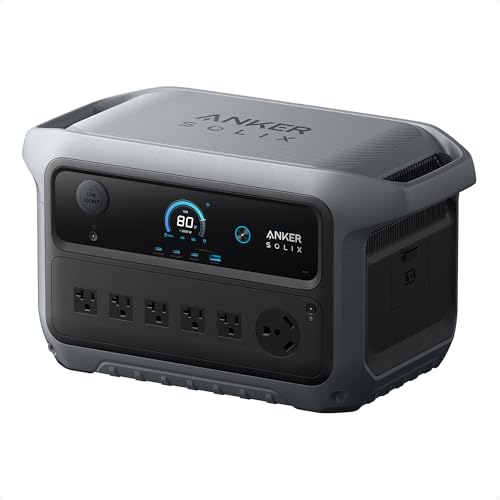
A portable power station can run a 1/2 HP sump pump only if it can supply the start-up: 2,645 VA for the Liberty 287, from Liberty's locked-rotor figure. A 2,048 Wh station that covers it, such as the Anker SOLIX C2000 Gen 2 (4,000 W peak), gives 1.8 hours of pumping.
Appliance figures from the makers' spec sheets and EnergyGuide labels. Prices checked Oct 28, 2026.
What will you run with your sump pump in an outage?
h/day920 W, 2645 W start
h/day5 W
h/day8 W
charges/day15 Wh per charge
Battery size you need, rated capacity
1,218Wh
3001k2k3k4k Wh
999 Whused in a day
933 Won AC at once
2,658 WAC at start-up
Counts 82% of a battery's rated capacity as usable and adds the inverter's own draw while anything runs on AC: the formula in Jackery's runtime calculator. How the maths works
Which models fit
If you buy through a link on this page, Amazon or the brand's store may pay us a commission. It does not change the price you pay, and it does not change which model the maths picks. As an Amazon Associate we earn from qualifying purchases. More about how the site is paid for.
Its 4,000 W peak covers the 2,645 VA start-up of a 1/2 HP Liberty pump, and its 2,048 Wh runs this page's outage-day list for 1.57 days, or 1.10 days with an hour of pumping a day.
2,048 Wh
2,400 W AC (4,000 W surge)
41.7 lb
Wall charge: 88 min to full
Runs a 1/2 HP sump pump 1.8 hours
$899.98$0.44/WhBuy on Amazon Amazon price on Oct 28, 2026
At 1,536 Wh it is the smallest station on this site that covers this page's outage day (1.18 days), and Jackery rates it at 4,000 W surge peak with a switch to battery within 10 ms.
EcoFlow rates it at 8,000 W surge, and its 4,096 Wh gives 3.6 hours of pumping from a 1/2 HP pump and runs the outage-day list with two hours of pumping a day for 1.37 days.
4,096 Wh
4,000 W AC (8,000 W surge)
113.54 lb
Wall charge: 0-80% in 50 min
Runs a 1/2 HP sump pump 3.6 hours
$2,799$0.68/WhBuy on Amazon Amazon price on Oct 28, 2026
Dabbsson rates it at 4,000 W surge, the highest of the 1,024 Wh stations here, so it starts a 1/2 HP Liberty pump. On its own battery it covers 84% of this page's outage day, and two DBS2000B batteries take it to 5,120 Wh.
1,024 Wh
2,000 W AC (4,000 W surge)
34.39 lb
Wall charge: 96 min to full
Runs a 1/2 HP sump pump 54 minutes
$619$0.60/WhBuy on Amazon Amazon price on Oct 28, 2026
How much power a sump pump draws
Liberty and Zoeller list amps on their spec sheets, not watts. Amps times the 115 V supply gives volt-amperes (VA). A motor's real watts are lower than its VA by its power factor, which neither maker prints. This page counts each VA figure as watts, so its runtimes are on the short side.
1/3 HP, Liberty 257: 5.2 A full load and 8 A locked rotor, per Liberty's 250 Series sheet. That is 598 VA running and 920 VA starting.
1/2 HP, Liberty 287: 8.0 A full load and 23 A locked rotor, per Liberty's 280 Series sheet, or 920 VA running and 2,645 VA starting.
1/2 HP, Zoeller M98: 9.4 A, or 1,081 VA running, per Zoeller's FM0532 sheet. Zoeller gives no locked-rotor figure.
3/10 HP, Zoeller M53: 9.7 A, or 1,116 VA running, on the same sheet, also with no locked-rotor figure.
Locked rotor is the current a motor draws for a moment as it starts. The two Zoeller pumps show that horsepower is a poor guide to the draw: the 3/10 HP M53 draws more than the 1/2 HP M98. Read the amps on your own pump's label and multiply by 115.
Start-up decides which stations can run it
A station can list two output ratings: continuous watts, and a peak (surge) figure for the moment a motor starts. The 1/2 HP Liberty 287 needs 920 W running and 2,645 W at start-up.
Peak covers it: every EcoFlow DELTA model (3,600 W surge and up), Anker SOLIX C1000 Gen 2 and C2000 Gen 2, Jackery Explorer 1000 v2, 1500 v2 and 2000 v2, BLUETTI Elite 100 V2 and AC180 (2,700 W), both Dabbsson models and the FOSSiBOT F2400.
Continuous output covers it: DJI Power 2000 (3,000 W) and Anker SOLIX F3800 Plus (6,000 W), which list no surge rating.
Start-up too high: DJI Power 1000 V2 (2,400 W, no surge rating), BLUETTI Elite 200 V2 (2,600 W; its 3,900 W Lifting Power is a boost mode, not a surge rating) and FOSSiBOT F1800 (1,800 W; its 2,400 W mode is for resistive loads).
Running draw too high: every station under 1,024 Wh, rated 700 W or less.
The 1/3 HP Liberty 257 starts at 920 W, which every station from 1,004.8 Wh up covers, as does the 286 Wh EcoFlow RIVER 3 Plus (1,200 W surge). Zoeller gives no starting figure, so the table checks the M98 and M53 on running watts only. Ask Zoeller for your pump's starting current.
How long each model runs it
One appliance at a time, from the makers' own figures, counting 82% of each battery as usable plus the inverter's own draw (method).
The table shows how long each station runs a pump that never stops. A pump with a float switch runs only while it empties the pit, then waits for the water to rise again, so the battery lasts longer on the clock than the table's figures.
How much pumping you need in a day depends on how fast water enters your pit, and that changes with the rain. The sizing tool starts at 30 minutes of pumping a day. That figure is our assumption, not a maker's, so change it to match your pit: in heavy rain, time how long the pump runs each time it switches on, and count how many times it switches on in an hour.
Hours of pumping from the 1/2 HP Liberty 287:
1,024 Wh station that can start it, such as the EcoFlow DELTA 3: 54 minutes
Jackery Explorer 1500 v2, 1,536 Wh: 1.3 hours
2,048 Wh station, such as the Anker SOLIX C2000 Gen 2: 1.8 hours
EcoFlow DELTA Pro 3, 4,096 Wh: 3.6 hours
The 1/3 HP Liberty 257 gets 1.4 hours from 1,024 Wh and 2.7 hours from 2,048 Wh.
Worked example: a day without power
The sizing tool on this page starts with an outage day for a 1/2 HP pump:
Liberty 287 sump pump, 30 minutes of pumping
Wi-Fi router, 24 hours
One LED bulb, 5 hours
Two phone charges
That list uses 999 Wh in a day. The total includes the inverter's own draw for all 24 hours, because the AC output stays on for the router and the pump: 15 W on a station of 1,000 to 1,499 Wh, from Jackery's calculator figures, applied to every brand. The runtime formula counts 82% of rated capacity as usable, so you need a station rated at 1,218 Wh or more.
A 1,024 Wh station that can start the pump covers 84% of that day, and the 1,152 Wh BLUETTI AC180 covers 95%. The Jackery Explorer 1500 v2 (1,536 Wh) covers 1.18 days, a 2,048 Wh station such as the Anker SOLIX C2000 Gen 2 covers 1.57 days, and the EcoFlow DELTA Pro 3 covers 3.14 days.
More rain, a different pump or a refrigerator
Each line below changes one thing in the worked example:
1 hour of pumping: the day needs a station rated at 1,867 Wh. A 2,048 Wh station covers 1.10 days.
2 hours of pumping: 2,989 Wh. Only the Anker SOLIX F3800 Plus (1.28 days) and the EcoFlow DELTA Pro 3 (1.37 days) cover it.
The 1/3 HP Liberty 257 in place of the 1/2 HP: 1,022 Wh. Every 1,024 Wh station covers it (1.00 days), including the DJI Power 1000 V2 and FOSSiBOT F1800, which cannot start the 1/2 HP pump.
The 1/2 HP Zoeller M98 in place of the Liberty: 1,316 Wh. The Jackery Explorer 1500 v2 covers 1.09 days.
Add a 21 cu ft refrigerator for 24 hours: 2,638 Wh. Only the F3800 Plus (1.46 days) and the DELTA Pro 3 (1.55 days) cover it.
The tool counts every other AC load on your list as running when the pump starts. With the refrigerator added, the start-up total is 2,703 W, more than the BLUETTI AC180's 2,700 W surge. The refrigerator's 45.5 W is a daily average, and this site has no start-up figure for it, so the real total at that moment can be higher. Try your own list in the sizing tool.
How to connect the pump in an outage
Plug the pump's own cord straight into one of the station's AC outlets. Leave the station's AC output switched on: a float switch can start the pump only when its outlet has power, so if your station can turn AC off when nothing draws power, turn that setting off.
If you keep the station plugged into the wall with the pump plugged into the station, a station with a UPS spec switches the pump to battery when the grid fails. Anker lists 10 ms for the SOLIX C2000 Gen 2, Jackery 10 ms for the Explorer 1500 v2, EcoFlow 10 ms for the DELTA Pro 3 and Dabbsson 15 ms (EPS) for the DBS1000 Pro.
A hard-wired pump has no plug to move, so it needs a transfer switch or power inlet installed by a licensed electrician. Never back-feed a house by plugging a station into a wall outlet.
A battery-backup sump pump is a different product
Battery-backup sump pump systems are a different product from a portable power station. This site has no figures for them, so it cannot compare their runtimes with the table above.
A portable power station is a battery with its own outlets, so the same unit can run other things in an outage. The Anker SOLIX C2000 Gen 2 runs each of these on its own for:
1/2 HP Liberty 287 sump pump: 1.8 hours of pumping
21 cu ft Whirlpool top-freezer refrigerator: 26 hours
ResMed AirSense 11 CPAP: 23 hours
eero 6+ Wi-Fi router: 3.1 days
For a CPAP, check with your doctor or equipment supplier about running it on battery power. There is more on sizing for a whole outage on the home backup page.
Questions people ask
Can a portable power station run a sump pump?
Yes, if its continuous output covers the pump's running draw and its peak covers the start-up. For a 1/2 HP Liberty 287 that is 920 VA running and 2,645 VA starting, and a 2,048 Wh station that covers both, such as the Anker SOLIX C2000 Gen 2, gives 1.8 hours of pumping.
Can I plug my sump pump into a battery backup?
You can plug a sump pump's cord straight into a portable power station's AC outlet if the station's continuous output covers the running draw and its peak covers the start-up: 920 VA and 2,645 VA for a 1/2 HP Liberty 287, 598 VA and 920 VA for a 1/3 HP Liberty 257. A battery-backup sump pump system is a different product, and this site has no figures for those.
What size power station do I need for a sump pump?
A 1/2 HP pump running 30 minutes a day, with a Wi-Fi router, one LED bulb and two phone charges, needs a station rated at 1,218 Wh for a full day. With an hour of pumping it needs 1,867 Wh, and with a 1/3 HP pump at 30 minutes, 1,022 Wh.
How long will a 1,000 Wh power station run a sump pump?
A 1,024 Wh station such as the EcoFlow DELTA 3 gives 54 minutes of pumping from a 1/2 HP Liberty 287 and 1.4 hours from a 1/3 HP Liberty 257. A pump that switches on and off lasts longer on the clock than its hours of pumping. Two 1,024 Wh stations, the DJI Power 1000 V2 and FOSSiBOT F1800, cannot start the 1/2 HP pump.
Can a small power station run a sump pump?
Of the four stations under 300 Wh on this site, only the EcoFlow RIVER 3 Plus can run the 1/3 HP Liberty 257: its 600 W output covers the 598 VA running draw and its 1,200 W surge covers the 920 VA start-up. It gives 23 minutes of pumping, and none of the four can run a 1/2 HP pump.
What should I do when the power goes out and I have a sump pump?
Move the pump's plug from the wall straight into a charged station whose peak covers its start-up, and check that the station's AC output is on. A station already set up as a UPS between the wall and the pump switches over by itself (Anker lists 10 ms for the SOLIX C2000 Gen 2). A hard-wired pump needs a transfer switch or power inlet installed by a licensed electrician.
Specifications are the makers' own published figures, read from these pages. Prices are fetched from the stores at build time and dated where they appear.