HomePortable power station for an RV: what size you need
Portable power station for an RV: what size you need
A boondocking day with a 12 V RV fridge, furnace blower, water pump, a ceiling light, a 12 V TV and two phone charges needs 2,593 Wh of rated capacity. A 2,048 Wh station covers 79% of that day, and only the 3,840 Wh and 4,096 Wh models here cover all of it.
Appliance figures from the makers' spec sheets and EnergyGuide labels. Prices checked Oct 28, 2026.
What will you run in your RV?
h/day65 W avg, up to 180 W (12 V)
h/day61 W (12 V)
h/day61 W avg, up to 90 W (12 V)
h/day4 W (12 V)
h/day32 W (12 V)
charges/day15 Wh per charge
Battery size you need, rated capacity
2,593Wh
3001k2k3k4k Wh
2,126 Whused in a day
0 Won AC at once
0 WAC at start-up
Counts 82% of a battery's rated capacity as usable and adds the inverter's own draw while anything runs on AC: the formula in Jackery's runtime calculator. How the maths works
Which models fit
If you buy through a link on this page, Amazon or the brand's store may pay us a commission. It does not change the price you pay, and it does not change which model the maths picks. As an Amazon Associate we earn from qualifying purchases. More about how the site is paid for.
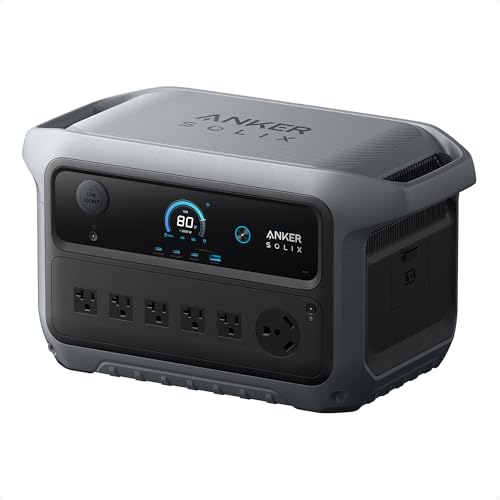
Anker rates it at 2,048 Wh with 800 W of solar input, a 12 V, 10 A car socket and expansion to 4,096 Wh. On its own it covers 79% of the boondocking day in the tool, which needs 2,593 Wh; expanded to 4,096 Wh, it covers all of it.
2,048 Wh
2,400 W AC (4,000 W surge)
41.7 lb
Wall charge: 88 min to full
Runs a 12 V fridge (Dometic CFX3 55IM) 7.4 days
$899.98$0.44/WhBuy on Amazon Amazon price on Oct 28, 2026
DJI lists 1,800 W of solar input, the most of any 2 kWh model here, and expansion to 22,528 Wh. On its own it covers 79% of the boondocking day in the tool, and it has 12 V car output only through the DJI Power SDC to Car Charger Plug Power Cable.
2,048 Wh
3,000 W AC
48.5 lb
Wall charge: 90 min to full
a 12 V fridge (Dometic CFX3 55IM): no 12 v socket
$749.99$0.37/WhBuy on Amazon Amazon price on Oct 28, 2026, sold by Yeehui Innovations
EcoFlow lists 4,096 Wh, 2,600 W of solar input and an 8,000 W peak, the highest peak here. It covers the boondocking day in the tool for 1.58 days, though it cannot be counted on to start a 13,500 BTU rooftop AC (8,107.5 W with the fan running).
4,096 Wh
4,000 W AC (8,000 W surge)
113.54 lb
Wall charge: 0-80% in 50 min
Runs a 12 V fridge (Dometic CFX3 55IM) 14.9 days
$2,799$0.68/WhBuy on Amazon Amazon price on Oct 28, 2026
Anker lists 3,840 Wh, 3,200 W of solar input (the most here) and expansion to 26,880 Wh; it covers the boondocking day in the tool for 1.48 days and weighs 135.6 lb.
These are the makers' figures for common RV appliances, with the hours a day the calculator assumes for each:
12 V compressor fridge:Furrion lists 566 kWh a year for its 19.6 cu ft French door model, an average of 64.6 W, or 1,550 Wh a day. The yearly figure already counts the time the compressor is off.
Furnace blower:Suburban lists 5.1 A at 12 V for its 20,000 BTU SF-Q furnace, or 61.2 W. Six hours of run time on a cold night uses 367 Wh.
Water pump: Shurflo's table for the Revolution 4008 pump gives 5.1 A at 30 PSI, also 61.2 W. Thirty minutes a day uses 31 Wh.
TV: Sylvox rates its 32-inch 12 V RV TV at 32 W, so 4 hours uses 128 Wh.
Lights and phones: an ITC LED ceiling light is rated 3.8 W (19 Wh for 5 hours), and a Samsung Galaxy S25 charge is about 15.4 Wh (4,000 mAh at an assumed 3.85 V).
CPAP:ResMed lists the AirSense 11 at 56.1 W typical and 73.2 W peak, so 8 hours on 12 V uses 449 Wh. Check with your doctor or equipment supplier about running your CPAP on battery power.
The fridge is the largest part of the day.
12 V appliances and AC appliances
A station's 12 V car socket powers 12 V appliances directly. Its AC outlets go through the inverter, which draws power of its own: the site counts 10 W under 1,000 Wh, 15 W from 1,000 to 1,499 Wh and 18 W from 1,500 Wh, using Jackery's calculator figures for every brand. On a 2,048 Wh station, a ResMed AirSense 11 runs 30 hours on 12 V and 23 hours from an AC outlet.
The fridge type matters most. On a 2,048 Wh station:
Furrion 19.6 cu ft 12 V compressor fridge: 26 hours
Norcold N8X absorption fridge on its 300 W, 120 V heater: 5.3 hours, counting the heater on all day (Norcold gives no duty cycle). The N8X also runs on LP gas, which takes the heater off the battery.
Dometic CFX3 55IM portable 12 V fridge (9.4 W average): 7.4 days
Every car socket here is rated 10 A except the DELTA Pro 3's 12 V output (30 A, per EcoFlow); the DELTA 3 Classic has none, and the DJI models need a DJI cable. Dometic rates the CFX3 55IM at 8.9 A. Furrion rates its 19.6 cu ft fridge at 15 A, more than a 10 A socket. Connecting a station to an RV's hard-wired appliances needs a power inlet installed by a licensed electrician.
How long each model runs it
One appliance at a time, from the makers' own figures, counting 82% of each battery as usable plus the inverter's own draw (method).
Why almost no portable station can start a rooftop AC
A rooftop air conditioner draws a lot to run and far more to start. Dometic's Brisk II figures at 115 V:
13,500 BTU (B57915): 1,713.5 W running (12.4 A compressor plus 2.5 A fan) and 7,820 W to start (68 A locked-rotor current).
15,000 BTU (B59516): 1,759.5 W running and 8,050 W to start (70 A locked-rotor current).
The highest peak ratings here are the EcoFlow DELTA Pro 3 at 8,000 W, the Anker SOLIX F3800 Plus at 6,000 W (the site has no separate peak figure for it, so its continuous output is used) and the EcoFlow DELTA 3 Max and FOSSiBOT F2400 at 4,800 W. Dometic's 7,820 W counts the compressor alone. The fan keeps running while the compressor cycles, so a restart also carries the fan's 287.5 W (2.5 A): 8,107.5 W, above the DELTA Pro 3's 8,000 W. The site uses that figure, so no station here passes the start-up check for either unit, though the DELTA Pro 3 is within 108 W of the smaller one.
Coleman-Mach lists 13.9 A (1,598.5 W) for the Mach 15 but no start-up current, so the calculator can check only its running watts. Eight hours a day of the 13,500 BTU Brisk II uses 13,852 Wh, which needs 16,893 Wh of rated capacity.
Worked example: a cold-weather boondocking day
The sizing tool above starts with this day, all on 12 V or USB:
Furrion 12 V fridge, 24 hours: 1,550 Wh
Furnace blower, 6 hours: 367 Wh
Water pump, 30 minutes: 31 Wh
One LED ceiling light, 5 hours: 19 Wh
12 V TV, 4 hours: 128 Wh
Two phone charges: 31 Wh
That is 2,126 Wh used, which needs 2,593 Wh of rated capacity, with 82% of it counted as usable. A 2,048 Wh station covers 79% of the day and the 2,330 Wh Dabbsson DBS2300 Plus 90%. The Anker SOLIX F3800 Plus lasts 1.48 days and the EcoFlow DELTA Pro 3 1.58 days.
Three changes and what they do:
No furnace (a warm night): 1,759 Wh used. A 2,048 Wh station covers 95% of the day, and the DBS2300 Plus lasts 1.09 days.
A portable Dometic CFX3 55IM in place of the built-in fridge: 801 Wh. A 1,024 Wh station lasts 1.05 days, a 2,048 Wh one 2.10 days.
A CPAP on 12 V for 8 hours added (check with your doctor or equipment supplier about running it on battery power): 2,575 Wh, which needs 3,140 Wh. The F3800 Plus lasts 1.22 days and the DELTA Pro 3 1.30 days.
Solar input limits
To stay out longer than one charge lasts, you recharge from solar panels, and each station accepts only so much solar power. The makers' limits for the 2 kWh and larger models:
Jackery Explorer 2000 v2: 400 W
EcoFlow DELTA 3 Max and FOSSiBOT F2400: 500 W
Anker SOLIX C2000 Gen 2 and Dabbsson DBS2300 Plus: 800 W
BLUETTI Elite 200 V2: 1,000 W
DJI Power 2000: 1,800 W
EcoFlow DELTA Pro 3: 2,600 W
Anker SOLIX F3800 Plus: 3,200 W
The worked example uses 2,126 Wh a day. This page does not estimate what panels deliver where you park, so the limit is the most a station accepts at one time, not what it collects in a day. A station takes no more than its limit, whatever the panels are rated.
Check the input voltage range too: Anker lists 11 to 60 V for the C2000 Gen 2, and BLUETTI 12 to 60 V for the Elite 200 V2. In the 1 kWh class, the DJI Power 1000 V2 accepts 1,800 W, the Dabbsson DBS1000 Pro 1,200 W, and the EcoFlow DELTA 3 Plus and BLUETTI Elite 100 V2 1,000 W each.
Expandable models for longer stays
Some stations take extra battery packs. The makers list these maximums:
Anker SOLIX C2000 Gen 2: 2,048 Wh, expandable to 4,096 Wh
Dabbsson DBS2300 Plus: 2,330 Wh to 8,330 Wh
EcoFlow DELTA Pro 3: 4,096 Wh to 12,000 Wh with two extra batteries
DJI Power 2000: 2,048 Wh to 22,528 Wh with up to ten expansion batteries
Anker SOLIX F3800 Plus: 3,840 Wh to 26,880 Wh
1 kWh class: EcoFlow DELTA 3 and DELTA 3 Plus to 5,000 Wh, Dabbsson DBS1000 Pro to 5,120 Wh, DJI Power 1000 V2 to 11,264 Wh
The boondocking day above needs 2,593 Wh of rated capacity, so the Anker SOLIX C2000 Gen 2 expanded to 4,096 Wh holds more than one such day. Capacity alone does not start a rooftop AC: eight hours of the 13,500 BTU Brisk II needs 16,893 Wh, which the DJI Power 2000 and F3800 Plus reach only when expanded. The site has no peak figure for either, and their continuous outputs (3,000 W and 6,000 W) are below that unit's start-up of 7,820 W for the compressor alone.
The runtimes and the table on this page use each station on its own. The list of every model shows each one's capacity, AC output and weight, and each model's page lists its solar input and expansion limit.
Questions people ask
What size portable power station do I need for an RV?
For a 12 V RV fridge, furnace blower, water pump, a ceiling light, a 12 V TV and two phone charges, you need 2,593 Wh of rated capacity a day: a 2,048 Wh station covers 79% of it, the Anker SOLIX F3800 Plus 1.48 days and the EcoFlow DELTA Pro 3 1.58 days. With a portable Dometic CFX3 55IM fridge in place of the built-in one, a 1,024 Wh station lasts 1.05 days.
Can a portable power station run an RV air conditioner?
Not reliably. Dometic lists 7,820 W to start the compressor of its 13,500 BTU Brisk II, and its fan adds 287.5 W while it runs, so a restart needs 8,107.5 W. The highest peak rating here is the EcoFlow DELTA Pro 3's 8,000 W. The 15,000 BTU Brisk II needs 8,050 W for the compressor alone.
How long will a power station run an RV fridge?
A Furrion 19.6 cu ft 12 V fridge averages 64.6 W, so a 1,024 Wh station runs it for 13 hours and a 2,048 Wh station for 26 hours. A Norcold absorption fridge on its 300 W AC heater runs 2.7 hours on a 1,024 Wh station; it also runs on LP gas, which takes the heater off the battery.
Can a portable power station run an RV microwave?
Furrion rates its 1.5 cu ft RV microwave at 1,500 W, so you need at least 1,500 W of AC output: every 1 kWh model here has that except the BLUETTI Elite 100 mini (700 W). A 1,024 Wh station runs it for 33 minutes, and 15 minutes of cooking uses 378 Wh.
Is a small portable power station enough for an RV?
Only for light 12 V loads. A 286 to 293.8 Wh station runs a 12 V furnace blower for 3.8 to 3.9 hours, a CPAP on 12 V for 4.2 to 4.3 hours and a Dometic CFX3 55IM portable fridge for 25 to 26 hours, but a built-in Furrion 12 V fridge for only 3.6 to 3.7 hours.
Can I run a CPAP in my RV from a power station?
A 2,048 Wh station runs a ResMed AirSense 11 for 30 hours on 12 V through ResMed's DC/DC converter, or 23 hours from an AC outlet. Ask your doctor or equipment supplier about running your CPAP on battery power.
Specifications are the makers' own published figures, read from these pages. Prices are fetched from the stores at build time and dated where they appear.