
Jackery Explorer 300
- 293.8 Wh
- 300 W AC (500 W surge)
- 7.1 lb
- Wall charge: 4.5 h to full
HomeCompareJackery vs Anker SOLIX: power stations compared size by size
This page matches Jackery and Anker SOLIX power stations at three sizes (under 300 Wh, 1 kWh and 2 kWh) on the specs each maker publishes. At 1 kWh and 2 kWh, Anker rates more continuous output, faster wall charging, more solar input and a 10 ms UPS switchover, and at every size the Jackery model weighs less.
For home backup, choose Anker SOLIX: the SOLIX C1000 Gen 2 rates 2,000 W against 1,500 W for the Explorer 1000 v2, so it runs a family-size microwave drawing 1,600 W that the Jackery cannot, and of the 2 kWh pair only the SOLIX C2000 Gen 2 takes an expansion battery (to 4,096 Wh). Choose Jackery if you carry the station or use it in heat: each Jackery here weighs less than its Anker match, and the Explorer 1000 v2 and 2000 v2 list discharging up to 113 °F against 104 °F for Anker. Under 300 Wh, the SOLIX C300 recharges in 70 minutes against about 4.5 hours for the Explorer 300 and has a 5-year warranty against 3 years, so choose the Explorer 300 only if its lower weight (7.1 lb against 9.1 lb) comes first.
If you buy through a link on this page, Amazon or the brand's store may pay us a commission. It does not change the price you pay, and it does not change which model the maths picks. As an Amazon Associate we earn from qualifying purchases. More about how the site is paid for.
| Spec | Jackery Explorer 300 | Anker SOLIX C300 |
|---|---|---|
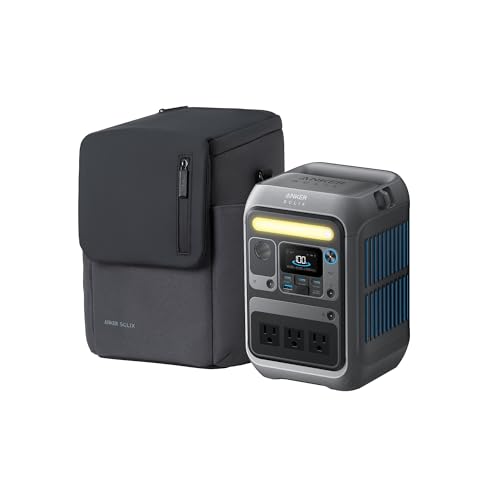
| Price today (lowest) | $289 | Only with a protective bag on Amazon ($369.99) |
| Price per Wh | $0.98/Wh | |
| Capacity | 293.8 Wh | 288 Wh |
| AC output, continuous | 300 W | 300 W |
| AC output, peak | 500 W | Not stated |
| AC outlets | 2 | 3 |
| Fastest USB-C port | 60 W | 140 W |
| 12 V car socket | Yes | Yes |
| Battery | Lithium-ion (cell chemistry not specified) | LFP |
| Cycle life | 800 cycles to 80%+ capacity | Not stated |
| Weight | 7.1 lb | 9.1 lb |
| Wall recharge | 4.5 h to full | 70 min to full |
| Max solar input | Not stated | 100 W |
| UPS switchover | Not stated | 10 ms |
| Expandable to | Not expandable | Not stated |
| Warranty | 3 years | 5 years |
| App | Not stated | Yes |
Capacity is close (293.8 Wh and 288 Wh) and both makers rate 300 W continuous, so runtimes are close: an AirSense 11 CPAP on AC runs 3.6 hours on either, and a Dometic CFX3 35 fridge on the 12 V socket runs 20 hours on either.
Choose the SOLIX C300 for faster charging, more USB-C power and a 5-year warranty (3 years on the Explorer 300), or the Explorer 300 if weight matters most.
| Spec | Jackery Explorer 1000 v2 | Anker SOLIX C1000 Gen 2 |
|---|---|---|
| Price today (lowest) | $519 | $499.99 |
| Price per Wh | $0.49/Wh | $0.49/Wh |
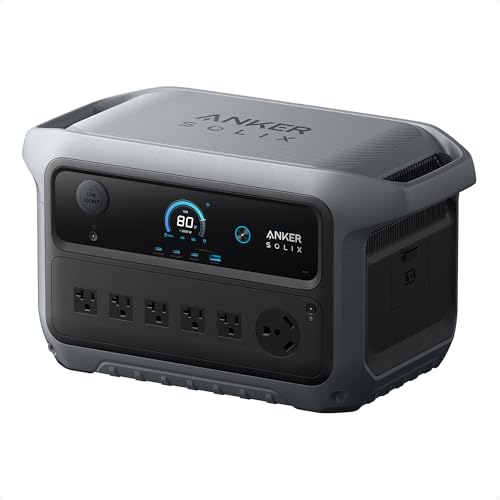
| Capacity | 1,070 Wh | 1,024 Wh |
| AC output, continuous | 1,500 W | 2,000 W |
| AC output, peak | 3,000 W | 3,000 W |
| AC outlets | 3 | 5 |
| Fastest USB-C port | 100 W | 140 W |
| 12 V car socket | Yes | Yes |
| Battery | LiFePO4 | LFP |
| Cycle life | 4000 cycles to 70%+ capacity | 4,000 cycles to 80% |
| Weight | 23.8 lb | 24.9 lb |
| Wall recharge | 60 min to full | 49 min to full |
| Max solar input | 400 W | 600 W |
| UPS switchover | Under 20 ms | Under 10 ms |
| Expandable to | Not expandable | Not expandable |
| Warranty | 5 years | 5 years |
| App | Yes | Yes |
Anker rates the SOLIX C1000 Gen 2 at 2,000 W continuous and Jackery rates the Explorer 1000 v2 at 1,500 W; both list a 3,000 W peak. The Anker runs a family-size microwave drawing 1,600 W (31 minutes) or a 1,875 W hair dryer (27 minutes); the Jackery runs neither. On loads both run, the Jackery's 1,070 Wh lasts slightly longer: a 21 cu ft top-freezer refrigerator runs 15 hours on it and 14 hours on the Anker.
Neither lists expansion. Choose the C1000 Gen 2 for appliances between 1,500 W and 2,000 W, more solar input or the faster switchover. Choose the Explorer 1000 v2 for slightly more capacity, lower weight or use in heat (discharging up to 113 °F against 104 °F).

| Spec | Jackery Explorer 2000 v2 | Anker SOLIX C2000 Gen 2 |
|---|---|---|
| Price today (lowest) | $999 | $899.98 |
| Price per Wh | $0.49/Wh | $0.44/Wh |
| Capacity | 2,042 Wh | 2,048 Wh |
| AC output, continuous | 2,200 W | 2,400 W |
| AC output, peak | 4,400 W | 4,000 W |
| AC outlets | 3 | 6 |
| Fastest USB-C port | 100 W | 140 W |
| 12 V car socket | Yes | Yes |
| Battery | LiFePO4 | LFP |
| Cycle life | 4000 cycles to 70%+ capacity | 4,000 cycles to 80% |
| Weight | 39.5 lb | 41.7 lb |
| Wall recharge | 102 min to full | 88 min to full |
| Max solar input | 400 W | 800 W |
| UPS switchover | Under 20 ms | Under 10 ms |
| Expandable to | Not expandable | 4,096 Wh |
| Warranty | 5 years | 5 years |
| App | Yes | Yes |
At 2,042 Wh and 2,048 Wh, these two give the same runtimes by the site's formula: 26 hours for a 21 cu ft top-freezer refrigerator, 23 hours for an AirSense 11 CPAP on AC and 14 hours for a Starlink Standard kit. The differences are in output, charging and expansion.
Choose the C2000 Gen 2 for home backup if you may add capacity later or want to charge from more solar panels. Choose the Explorer 2000 v2 for the higher surge rating on an appliance with a large start-up draw, the lower weight, or use in heat (discharging up to 113 °F against 104 °F).

| Jackery | Anker SOLIX | |
|---|---|---|
| Warranty | Product pages for the Explorer 1000 v2, 1500 v2 and 2000 v2 state 3 years plus 2; the extra years are automatic on jackery.com orders and need free registration for orders bought elsewhere. Jackery's service policy page lists shorter terms for some series | 60 months (5 years) on current AC power stations in Anker's warranty table; its registration page says registering activates the 5-year protection |
| Returns (brand store) | 30 days from receiving the order | 30 days from delivery, in original packing |
| App | Jackery app | Anker app |
| US support | 1-888-502-2236, Mon-Fri 9 am-6 pm PT | +1 (800) 988-5541, Mon-Fri 9 am-5 pm PT |
| Founded | 2012 | Not stated |
| Model | Capacity | AC output | Lowest price today | Per Wh |
|---|---|---|---|---|
| Anker SOLIX C300 | 288 Wh | 300 W | Not available | |
| Jackery Explorer 300 | 293.8 Wh | 300 W | $289 | $0.98/Wh |
| Anker SOLIX C1000 Gen 2 | 1,024 Wh | 2,000 W | $499.99 | $0.49/Wh |
| Jackery Explorer 1000 v2 | 1,070 Wh | 1,500 W | $519 | $0.49/Wh |
| Jackery Explorer 1500 v2 | 1,536 Wh | 2,000 W | $849 | $0.55/Wh |
| Jackery Explorer 2000 v2 | 2,042 Wh | 2,200 W | $999 | $0.49/Wh |
| Anker SOLIX C2000 Gen 2 | 2,048 Wh | 2,400 W | $899.98 | $0.44/Wh |
| Anker SOLIX F3800 Plus | 3,840 Wh | 6,000 W | $2,599.99 | $0.68/Wh |
Both brands give 5 years on the 1 kWh and 2 kWh models compared here. What differs is what you must do to get the full term.
Returns under each brand's own policy run 30 days: from when you receive the order at Jackery, and from delivery at Anker, which also asks for the original packing. Refurbished units from both brands carry a 6-month warranty, not 5 years. Compare the two programs on refurbished power stations.
Anker's stated wall-charging times are shorter at each matched size: 70 minutes to full for the SOLIX C300, 49 minutes for the C1000 Gen 2 and 88 minutes for the C2000 Gen 2. Jackery's fastest v2 figures use a named charging mode: 1 hour for the Explorer 1000 v2 and 102 minutes for the 2000 v2 in Emergency Super Charge, and 64 minutes for the Explorer 1500 v2 (1,536 Wh) in Fast Charging Mode.
Solar input differs more:
The solar figure is the most panel power the station accepts, so it limits how fast panels can recharge it. At 1 kWh and 2 kWh, the gap matters only if your panels add up to more than 400 W. If you plan to recharge from solar at a campsite or through a long outage, compare this figure as well as capacity.
A UPS switchover is the time a plugged-in station takes to move your devices to battery when wall power cuts out. Every model from these two brands on this site lists one except the Explorer 300:
Only Anker offers expansion among these models. The C2000 Gen 2 expands to 4,096 Wh and the F3800 Plus to 26,880 Wh. None of the four Jackery models on this site lists an expansion battery, so buy the capacity you need at the start. The sizing tool adds up what you plan to run and lists the models that fit.
Both brands have an app: the Jackery app for the Explorer v2 models and the Anker app for every Anker model here. Jackery does not list an app for the Explorer 300.
For home backup, Anker's specs fit better at 1 kWh and 2 kWh: more continuous output, a 10 ms switchover and, on the C2000 Gen 2, expansion to 4,096 Wh. Battery size, not brand, sets runtime at each size:
If you prefer Jackery and need more than 1,500 W, the Explorer 1500 v2 rates 2,000 W, a 4,000 W surge and a 10 ms switchover.
For camping, weight, temperature range and 12 V use matter more. Each Jackery weighs less than its Anker match: 7.1 lb against 9.1 lb under 300 Wh, 23.8 lb against 24.9 lb at 1 kWh and 39.5 lb against 41.7 lb at 2 kWh.
If you camp with a CPAP, check with your doctor or equipment supplier about running it on battery power. An AirSense 11 on AC runs 12 hours on either 1 kWh model.
It depends on what you run and whether you carry it. At 1 kWh and 2 kWh, Anker rates more continuous output (2,000 W and 2,400 W against Jackery's 1,500 W and 2,200 W), more solar input, a 10 ms UPS switchover and faster wall charging, and the C2000 Gen 2 expands to 4,096 Wh. Jackery's models weigh less at each size, the Explorer 2000 v2 has the higher surge rating (4,400 W against 4,000 W), and the Explorer 1000 v2 and 2000 v2 list discharging up to 113 °F. For home backup, Anker's specs fit better; for carrying and hot-weather camping, Jackery's do. To compare cost, the price per Wh table sorts every model by price per watt-hour.
The specs on this site do not answer that, so check your model's user manual or ask Jackery support. What Jackery does list is a UPS switchover on the Explorer 1000 v2, 1500 v2 and 2000 v2: when the station is plugged in and wall power cuts out, it moves your devices to battery within 20 ms (1000 v2 and 2000 v2) or 10 ms (1500 v2). Jackery says the 2000 v2's switchover keeps a router, computer and NAS online, a use in which the station stays plugged in. Jackery does not state a switchover for the Explorer 300.
Anker, at each matched size. Anker states 70 minutes to full for the SOLIX C300, 49 minutes for the C1000 Gen 2 and 88 minutes for the C2000 Gen 2. Jackery states about 4.5 hours for the Explorer 300 on its wall charger, and 1 hour for the Explorer 1000 v2 and 102 minutes for the 2000 v2, both in Emergency Super Charge mode. On solar, Anker accepts 600 W on the C1000 Gen 2 and 800 W on the C2000 Gen 2, against 400 W on Jackery's v2 models.
Among the models on this site, only Anker's. Anker states the SOLIX C2000 Gen 2 expands to 4,096 Wh and the SOLIX F3800 Plus to 26,880 Wh. Jackery does not list expansion for the Explorer 300, 1000 v2, 1500 v2 or 2000 v2, and Anker does not list it for the C300 or C1000 Gen 2.
On the 1 kWh and 2 kWh models compared here, both give 5 years, with different conditions. Jackery's Explorer 1000 v2, 1500 v2 and 2000 v2 get 3 years plus 2: the extra 2 are automatic on jackery.com orders and need free registration if you buy elsewhere. Anker's registration page says registering activates its 5-year protection. Under 300 Wh, the SOLIX C300 has 5 years and the Explorer 300 has 3. Refurbished units from both brands carry 6 months.
Choose the C1000 Gen 2 if you run anything between 1,500 W and 2,000 W, such as a family-size microwave drawing 1,600 W, or want 600 W of solar input. Choose the Explorer 1000 v2 for 1,070 Wh against 1,024 Wh, 23.8 lb against 24.9 lb, and discharging up to 113 °F. Both spec tables are on Explorer 1000 v2 vs SOLIX C1000 Gen 2.
Specifications are the makers' own published figures, read from these pages. Prices are fetched from the stores at build time and dated where they appear.